By James Rounsville
A Statement Worth Paying Attention To
“Inference is the monetization of AI investment.”
— CoreWeave CEO, GTC
At first glance, it sounds like a simple observation.
It’s not.
Translation: Where the Money Actually Goes
Strip it down, and the economics become clear:
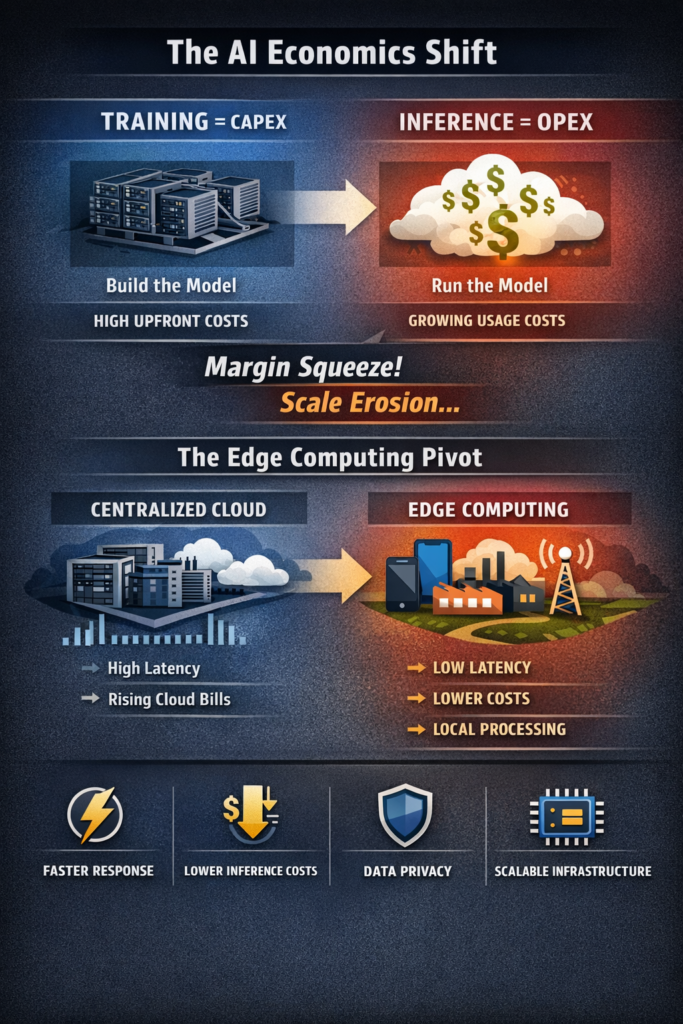
- Training = CapEx
- Inference = OpEx at scale
Training is a one-time (or periodic) investment.
Inference is continuous.
Relentless.
And directly tied to usage.
The Hidden Pressure: Scaling Costs With Success
Every AI company is about to face the same reality:
As users grow, compute costs scale with them.
More prompts → more inference
More customers → more infrastructure
More success → tighter margins
This is where the pressure begins.
The Margin Compression Problem
AI doesn’t behave like traditional software.
In SaaS:
- Revenue scales faster than cost
In AI:
- Cost scales with usage
That creates a fundamental challenge:
Margin compression becomes inevitable unless something changes.
The Strategic Pivot Already Underway
That “something” is becoming increasingly clear:
Edge computing.
Moving inference closer to the user—rather than relying entirely on centralized infrastructure—offers:
- Reduced latency
- Lower cloud dependency
- Improved cost efficiency at scale
And most importantly:
A path to protect margins.
Why This Shift May Happen Faster Than Expected
Consensus tends to lag inflection points.
But the incentives here are immediate and powerful:
- Rising compute costs
- Competitive pricing pressure
- User growth outpacing infrastructure efficiency
That combination accelerates change.
What This Means for AI Companies
The next phase of AI competition won’t just be about:
- Model quality
- Benchmark performance
- Feature sets
It will be about economic architecture.
Who can deliver intelligence:
- Faster
- Cheaper
- Closer to the user
Final Thought
Training built the foundation.
Inference defines the business.
And the companies that understand that shift early—
Will be the ones that scale profitably, not just successfully.