By James Rounsville
The question shaping the next generation of security platforms
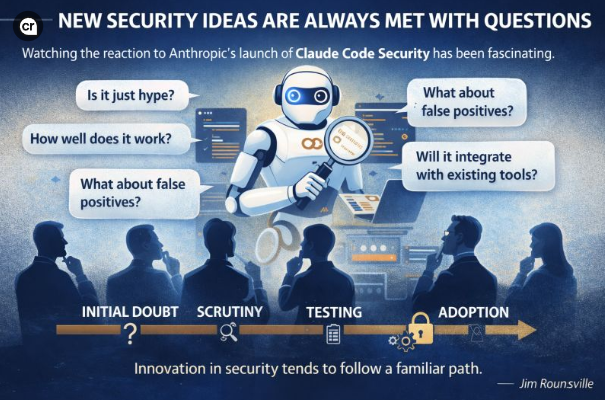
The Question Beneath the Surface
There’s a larger question quietly sitting underneath the technical debate:
Will reasoning-driven AI security capabilities displace existing security platforms?
It’s a fair concern.
Why This Moment Feels Different
When a new security model emerges—especially one powered by large-scale AI reasoning—it naturally raises questions about the incumbents:
- CrowdStrike
- Zscaler
- Palo Alto Networks
- And others who have built powerful ecosystems around detection, prevention, and response
These platforms define today’s security landscape.
So what happens when the model itself begins to change?
What History Tells Us
There’s a pattern worth paying attention to:
New security primitives rarely eliminate entire categories overnight.
More often, they reshape them.
What Reasoning-Based Security Could Change
If reasoning-based vulnerability analysis proves effective at scale, the impact may be significant—but not immediately disruptive.
Instead, it could:
- Improve signal quality for endpoint and cloud detection platforms
- Reduce alert fatigue before runtime protection is even triggered
- Enhance DevSecOps workflows across code-to-cloud pipelines
- Create new integration layers rather than force immediate replacement
This is less about disruption—and more about augmentation.
Security Is Not a Zero-Sum Stack
Cybersecurity has never been a winner-take-all system.
It’s layered.
It’s interconnected.
It evolves in place.
New capabilities don’t exist in isolation—they plug into, refine, and extend what already exists.
Where the Real Shift Could Happen
That said, it would be naïve to assume AI-native security capabilities won’t influence market structure over time.
If reasoning engines mature to operate across:
- Runtime telemetry
- Network behavior
- Application code
…then we could see meaningful shifts in how platforms differentiate.
Not overnight—but inevitably.
Integration First. Evolution Next.
The most likely near-term outcome?
Integration.
The longer-term possibility?
Evolution.
Final Thought
This isn’t destabilization.
It’s progression.
Because in cybersecurity, the stack doesn’t collapse—
It adapts, absorbs, and advances.
That’s how this industry moves forward.