By James Rounsville
The Pitch Everyone Understands
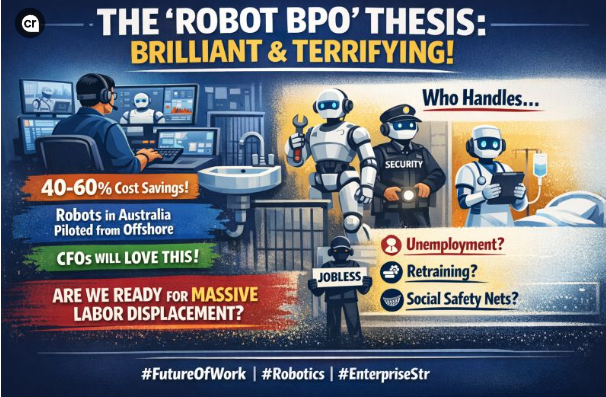
The “Robot BPO” thesis is both brilliant… and deeply unsettling.
At its core, the model is simple:
- Robots deployed in Australia
- Operated remotely from Malaysia
- 40–60% cost savings
CFOs will love it.
Margins improve.
Labor arbitrage scales.
Shareholders applaud.
Zooming Out: This Isn’t Just Outsourcing
We’ve seen this pattern before.
- When you offshore customer service, you move jobs.
- When you offshore physical labor through robots, you remove them.
That distinction changes everything.
A World of Remote Physical Labor
What happens when your:
- Plumber is remote
- Security guard is remote
- Nurse is remote
- Warehouse crew is remote
This isn’t theoretical anymore.
It’s operational.
The Real Question: Velocity
The issue isn’t whether this will happen.
It’s how fast.
At what velocity does local employment erode?
Because velocity determines whether societies adapt… or fracture.
It’s Not About Innovation
Let’s be clear:
- Innovation isn’t the problem.
- Incentives aren’t the problem.
The market is doing exactly what it’s designed to do—optimize for efficiency and cost.
The real issue is readiness.
Are We Prepared For What Comes Next?
Are we prepared for:
- Large-scale labor displacement?
- Retraining at unprecedented speed?
- Rebuilding social safety nets for a hybrid human–robot economy?
Because right now, technology is accelerating faster than:
- Policy
- Education
- Workforce adaptation
Short-Term Winners, Long-Term Consequences
The companies that adopt this model early may win.
- Lower costs
- Higher margins
- Competitive advantage
But if systemic impacts go unaddressed, the long-term consequences won’t be isolated.
They’ll be shared.
The Future Is Already Here
The future of work isn’t coming.
It’s here.
Final Thought
The real question isn’t whether we can build this future.
It’s whether we’re building the economic infrastructure to sustain it.