By James Rounsville
A Personal Baseline
I use OpenAI daily as my primary AI tool.
So when OpenAI raises $110B, it’s easy to focus on the headline.
But that misses the point.
This Isn’t About Valuation
Let’s be clear:
- Not about valuation
- Not about hype
- About infrastructure
When one company absorbs capital equal to a majority of annual U.S. venture funding, it tells us something fundamental:
AI is no longer an application-layer experiment.
It’s becoming core infrastructure.
What This Means for Engineers
For the average engineer, your environment is about to change—whether you asked for it or not.
Expect:
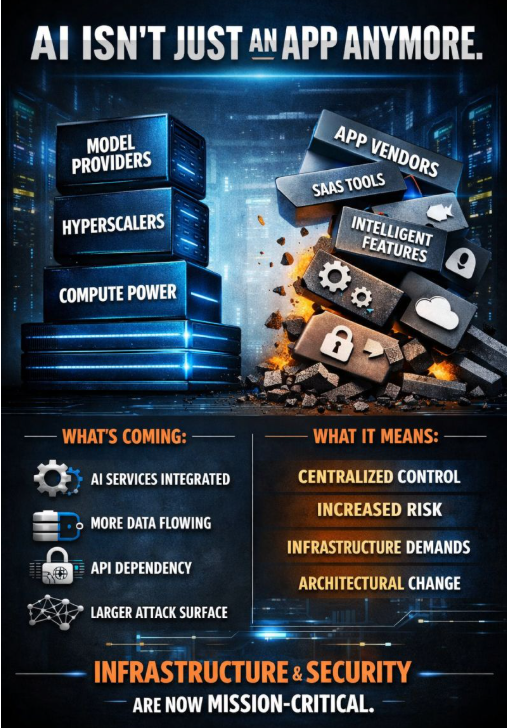
- More AI services embedded into tools you already use
- More “intelligent” features pushed into your SaaS stack
- More data flowing to models you don’t control
- More infrastructure requirements to support it
This isn’t optional adoption.
It’s ambient integration.
What This Means for the C-Suite
For CEOs and CFOs, the signal is different—but just as important:
AI is moving from discretionary spend to mandatory capability.
The companies that survive won’t be the ones that bolt on AI features.
They’ll be the ones that:
Redesign their architecture around it.
The Pressure Beneath the Surface
Here’s the part few are discussing:
When capital concentrates at the foundation layer—
model providers, compute, hyperscalers—
Pressure increases everywhere else.
- Application vendors compress
- Consolidation accelerates
- Margins tighten
- Budgets reallocate
This is structural.
Not cyclical.
The Deeper Risk: Centralized Intelligence
Underneath all of it is a more consequential issue:
As intelligence centralizes, risk centralizes.
That means:
- More model access
- More API dependency
- More east–west traffic
- More attack surface
And that’s where technical leadership becomes critical.
This Is an Architectural Moment
This moment isn’t about chasing AI.
It’s about preparing your architecture for what AI changes:
- Propagation
- Data gravity
- Control boundaries
- Deterministic containment
These aren’t features.
They’re design principles.
Who Wins in This Shift
The engineers who understand infrastructure will become indispensable.
The executives who understand architectural impact will outpace competitors.
Because this shift isn’t cosmetic—
It’s foundational.
Final Thought
This isn’t just a funding round.
It’s a shift in the physics of enterprise technology.
Plan accordingly.