By James Rounsville
The First Question Everyone Asks
In my last post about Claude Code Security, I noted a common reaction to new security technology:
“Is this replacing what I already have?”
It’s a natural question.
And in this case, the answer is clear:
No.
Introducing a Different Kind of Control
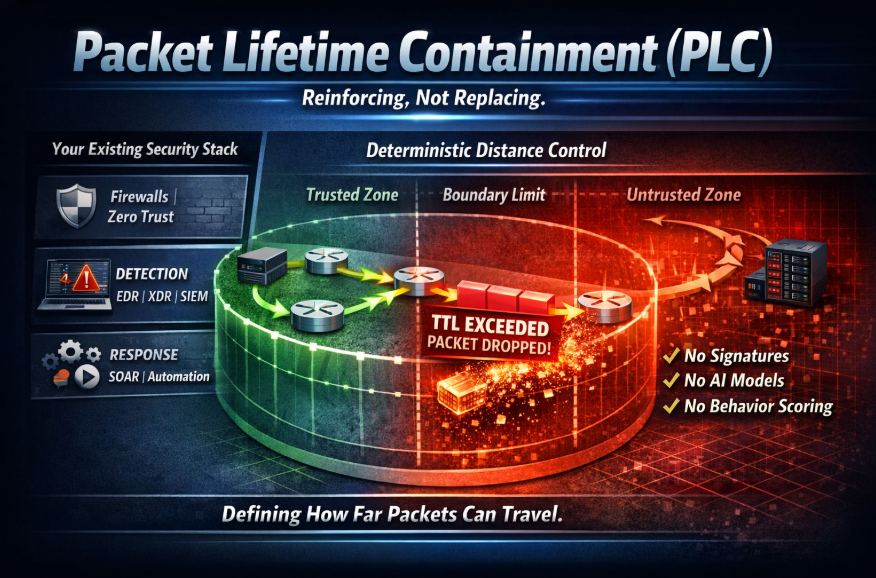
We introduced a solution called Packet Lifetime Containment (PLC).
It isn’t a replacement for anything.
It’s a native Layer 3 enforcement capability designed to complement everything you already run.
How Modern Security Is Structured
Most security architectures today operate across three primary planes:
1. Policy
- Firewalls
- ZTNA
- Segmentation
2. Detection
- EDR
- NDR
- SIEM
- XDR
3. Response
- SOAR
- Automation
These systems are powerful.
But at their core, they are probabilistic.
They:
- Decide
- Detect
- React
Where PLC Changes the Model
PLC introduces something fundamentally different:
Deterministic Propagation Control
At Layer 3, every packet carries a Time-To-Live (TTL).
PLC leverages this native mechanism to define containment boundaries—limiting how far traffic can propagate across routed domains.
What Makes It Different
This approach is not:
- Based on signatures
- Based on AI models
- Based on behavior scoring
Instead:
If traffic exceeds its defined boundary, it stops. Every time.
No interpretation.
No delay.
No ambiguity.
Not Competitive — Complementary
PLC does not compete with your existing stack.
It strengthens it.
- Firewalls enforce who can talk
- Detection platforms identify compromise
- Analytics systems correlate activity
PLC constrains the blast radius—even when something slips through.
Why This Matters Now
We are entering an era defined by:
- AI-driven systems
- Autonomous operations
- Machine-speed execution
In that environment, security cannot rely on visibility and response alone.
Because response always comes after something has already happened.
The Power of a Hard Boundary
Sometimes the most powerful control isn’t another alert.
It’s a boundary that simply cannot be crossed.
Final Thought
This isn’t about replacing your stack.
It’s about reinforcing it.
Adding a layer of deterministic control in a world increasingly driven by probabilistic systems.