“The internet today is protected by math designed in the 1970s and 80s. Post-quantum cryptography is the effort to rebuild that mathematical foundation before quantum computers arrive and crack the old one.”
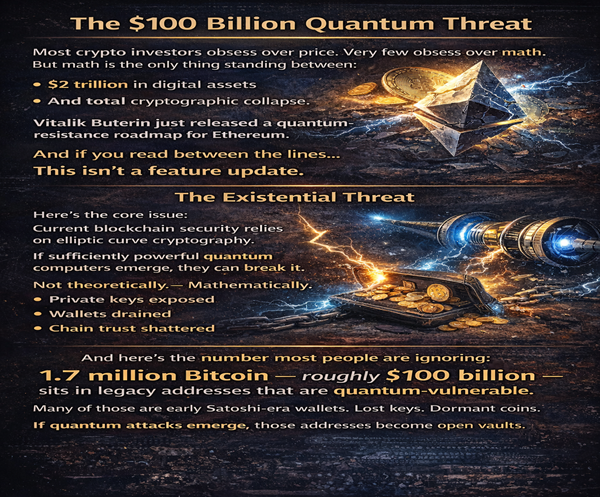
Most crypto investors obsess over price. Very few obsess over math. But math is the only thing standing between:
- $2 trillion in digital assets
- And total cryptographic collapse.
Vitalik Buterin just released a quantum-resistance roadmap for Ethereum.
And if you read between the lines…
This isn’t a feature update.
It’s a survival strategy.
The Existential Threat
Here’s the core issue:
Current blockchain security relies on elliptic curve cryptography. If sufficiently powerful quantum computers emerge, they can break it.
Not theoretically. — Mathematically.
That means:
- Private keys exposed.
- Wallets drained.
- Chain trust shattered.
And here’s the number most people are ignoring:
1.7 million Bitcoin — roughly $100 billion — sits in legacy addresses that are quantum-vulnerable.
Many of those are early Satoshi-era wallets. Lost keys. Dormant coins.
If quantum attacks emerge, those addresses become open vaults.
The Nuclear Option: Supply Burn
To prevent mass theft, one solution under discussion:
Burn vulnerable coins.
Destroy them.
Up to 5% of Bitcoin’s total supply could be permanently removed during a quantum transition.
We have never seen deflationary pressure like that in crypto history. This isn’t halving-cycle scarcity. This is forced extinction of dormant capital. And that creates a paradox: Security upgrade / Through economic destruction.
AI Acceleration Changes the Timeline
For years, quantum risk was filed under: “2035 problem.”
But AI is accelerating quantum research.
- Design optimization.
- Error correction modeling.
- Material simulation.
Some experts now believe the timeline could compress into the late 2020s.
That’s not far away. Infrastructure migrations at global scale take years. Which means planning must happen now.
Ethereum’s Strategic Move
Vitalik’s roadmap is methodical. Vitalik’s roadmap is methodical. Ethereum plans to integrate NIST-approved post-quantum cryptography. Hash-based signatures like SPHINCS+.
SPHINCS+ is a quantum-resistant digital signature system that protects transactions using massive layers of hash-based security instead of the math that quantum computers can break. SPHINCS+ sounds a lot like some secret government project. It’s really just a different way to sign digital messages so attackers can’t fake them.
Here is the Problem SPHINCS+ Solves
Crypto currencies like Bitcoin and Ethereum — currently use a type of cryptography called elliptic curve signatures.
These signatures prove that: “This transaction came from the real owner of the key.”
The problem?
A powerful quantum computer could eventually break that math.
If that happens, attackers could:
- Forge signatures
- Steal crypto
- Impersonate systems
- Break secure communications
So researchers needed a new type of signature that even quantum computers can’t crack.
The Simple Way to Think About SPHINCS+
Think of cryptography like locks on doors.
Current crypto uses very complicated locks that are extremely hard to pick — for normal computers.
But using a quantum computer you can create a master lock-picking machine.
Why It’s More Secure
SPHINCS+ is considered quantum-resistant because it relies on hash functions, and no known quantum algorithm can efficiently break those.
So even if quantum computers appear, the security assumptions still hold.
That’s why it was selected by NIST as one of the official post-quantum cryptography standards.
The Trade-Off
Security comes with a price.
SPHINCS+ signatures are much bigger. Instead of a tiny digital signature, you might need something closer to 10 kilobytes.
That’s about 10–20 times larger than what many systems use today. So it’s like replacing a small key with a large security folder full of keys.
More secure. But heavier.
Why It Matters for Crypto
Blockchains rely entirely on digital signatures.
If signatures break, ownership breaks.
SPHINCS+ is one of the leading tools that could allow:
- Bitcoin
- Ethereum
- and other networks
to survive the quantum era.
These signatures offer mathematical security against quantum attacks.
But they come with tradeoffs:
- Signatures are 10x larger.
- SPHINCS+ can require ~10KB per signature.
- Increased storage.
- Increased computational overhead.
Security isn’t free.
It’s heavy.
But here’s where Ethereum may have an advantage:Account abstraction.
Ethereum’s architecture allows more flexible signature schemes without breaking existing smart contracts.
Bitcoin’s conservative design philosophy makes sweeping cryptographic changes more culturally and technically difficult.
That difference matters.
The Capital Flight Scenario
Now let’s talk markets.
If quantum risk becomes credible and immediate…
Capital moves. Fast. We’ve seen this pattern before:
- On-premise companies lost to cloud-first platforms.
- Feature phones collapsed when smartphones matured.
- Mainframe vendors fell to distributed computing.
Sudden technological obsolescence creates nonlinear market shifts.
The leader becomes the laggard.
The prepared network becomes the safe haven.
If Ethereum successfully implements quantum resistance first…
Could it capture massive capital flight from Bitcoin?
That’s not tribalism. That’s capital preservation logic.
The Market Cap Reshuffle Question
So here’s the strategic question: Could the quantum transition reshuffle the entire crypto market cap hierarchy?
If 5% of Bitcoin supply is burned… If institutional allocators begin pricing quantum risk… If insurance underwriting begins demanding quantum-resilient custody… Then we’re not talking about incremental movement. We’re talking about structural repricing.
Crypto has never faced a true cryptographic extinction-level event. This would be the first.
The Winner-Take-All Pattern
This isn’t just about crypto. This is about how technological obsolescence works.
When core infrastructure becomes vulnerable:
- Late movers collapse.
- Early movers absorb liquidity.
- Neutral players get crushed in between.
Think:
BlackBerry vs iPhone.
Blockbuster vs Netflix.
Kodak vs digital sensors.
When foundational assumptions break, brand loyalty doesn’t save you. Adaptation speed does.
Crypto markets pretend decentralization guarantees resilience. But decentralization does not eliminate math.
It only distributes governance.
The Coordination Problem
Here’s the hidden challenge:
Upgrading cryptography requires synchronized action across:
- Wallets
- Exchanges
- Custodians
- Validators
- Smart contracts
- Layer 2s
- Cross-chain bridges
If even one major infrastructure layer lags…
You create exploit windows.
This may be one of the most complex coordinated upgrades in blockchain history.
And history shows coordination at scale is difficult.
The Psychological Layer
Nick Carter recently warned: “Bitcoin developers are sleepwalking toward collapse.”
That may be hyperbolic. But it captures something real: Complacency risk.
When something has never been broken, humans assume it cannot break. Quantum computing changes that assumption.
Gradually at first. Then suddenly.
The Deeper Pattern
Look at the through-line across today’s segments:
Segment 1:
AI reshaping military power.
Segment 2:
AI reshaping geopolitical finance.
Segment 3: Quantum + AI threatening digital monetary infrastructure.
This is infrastructure realignment.
Every major digital system built in the last 20 years is now being stress-tested by emerging compute power.
The Strategic Question
If quantum transition creates winners and losers…
Who are the early quantum-native chains?
Who is already building with post-quantum primitives?
a growing number of organizations are already experimenting with or implementing post-quantum cryptography (PQC)—the building blocks sometimes called post-quantum primitives (new signature schemes, key exchanges, and hashes designed to resist quantum attacks). The effort spans blockchains, major tech companies, security vendors, and governments.
- Quantum Resistant Ledger (QRL)
- Ethereum Research Community
- Cloudflare
- IBM
- Microsoft
- NIST PQC Program (U.S. Government)
The Four Major Post-Quantum Primitives Being Adopted
| Algorithm | Purpose | Type |
| Kyber | Encryption / key exchange | Lattice-based |
| Dilithium | Digital signatures | Lattice-based |
| Falcon | Digital signatures | Lattice-based |
| SPHINCS+ | Digital signatures | Hash-based |
These are the foundations of the post-quantum internet.
Why This Matters Strategically
Quantum migration is not like a normal software upgrade.
It requires updating:
- browsers
- servers
- blockchains
- banking infrastructure
- satellites
- military communication systems
That’s billions of devices.
Which is why organizations are starting years before the threat becomes real.
And more importantly:
Will institutional capital wait for a breach…
Or move preemptively?
Because the first credible quantum exploit against a major wallet could trigger immediate contagion.
Confidence evaporates faster than hash rate.
Final Reflection
Crypto was born from distrust of centralized finance. But it still trusts mathematics.
Quantum computing challenges that trust. Vitalik’s roadmap isn’t marketing. It’s defensive architecture.
And history teaches us something: When foundational security assumptions shift…
Entire industries reorganize. The question isn’t whether quantum transition happens.
The question is: Who moves first?
And in crypto — First movers don’t just win. They absorb.