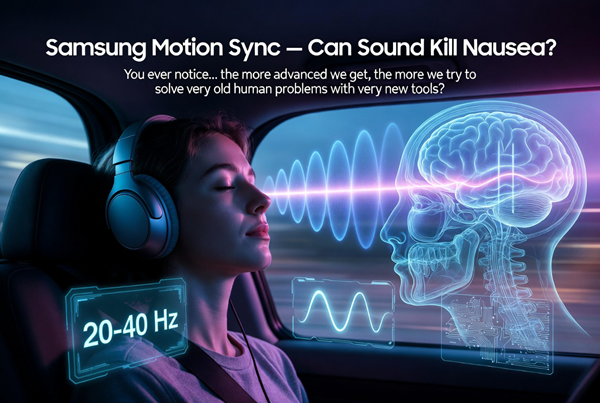
You ever notice… the more advanced we get, the more we try to solve very old human problems with very new tools?
Motion sickness isn’t new.
It’s primal.
Your inner ear (vestibular system) senses motion. Your eyes may see little or no movement (like reading in a car). Your body feels something different.
And historically? We’ve dealt with it the same ways for decades
- pills that make you drowsy…
- bands that may or may not work…
- or just toughing it out.
- Looking out the window (aligning vision with motion) helps
- Closing your eyes sometimes helps
- Reading or screens make it worse
7 Reasons Why Some People Get Motion Sickness Worse Than Others
It comes down to how sensitive and adaptable your system is to that sensory conflict.
1. Inner Ear Sensitivity (Primary Factor)
- Some people have a more sensitive vestibular system—that balance system in your inner ear.
- More sensitivity = stronger signal of motion
- Stronger signal + conflicting input = faster nausea response
Think of it like a sensor set too high—it overreacts.
2. Brain Processing & Adaptation
- Your brain can learn to reconcile motion over time.
- People who travel a lot (pilots, sailors, soldiers) often adapt
- Others don’t get that exposure, so their brain never calibrates
This is why “sea legs” are real.
3. Age
- Children (ages 2–12) are the most susceptible
- It often improves in adulthood
- Some people regain sensitivity later in life
4. Visual Dependence
- Some people rely heavily on their eyes to understand movement.
So when:
- Eyes say “still” (reading, screens)
- Inner ear says “moving”
They get hit harder.
5. Genetics
- There’s a hereditary component.
- If your parents had motion sickness… there’s a good chance you will too.
6. Fatigue, Stress, and Health
Your baseline condition matters.
- Tired → worse
- Dehydrated → worse
- Stressed → worse
Your system has less tolerance for mismatch.
7. Environment & Position
Where you are matters:
- Back seat of a car → worse
- Wing of a plane (more stable) → better
- Rough seas → worse
So here we have Samsung stepping in and claiming: “We can fix that… with sound”
They’ve launched an app—Motion Sync. Free for Samsung android phones. No special hardware. Just headphones.
- It plays low-frequency tones—20 to 40 hertz— right on the edge of what you can even hear.
The idea?
- Those frequencies help “synchronize” your senses.
- Bring your inner ear and brain back into alignment.
In plain terms:
- They’re trying to tune your body like an instrument.
When someone tells you they can solve a biological problem with
- something invisible…
something you can’t verify…
something that operates below your awareness…
You don’t reject it. But you don’t trust it either.
You observe.
Here’s what we know:
- Motion sickness hits up to 40% of people
- That’s over 100 million Americans dealing with it regularly
- There’s real money here—an $800 million pharma market
- And now… a $4+ billion digital therapeutics market growing fast
So make no mistake—this isn’t just about helping you on a road trip. This is about who owns the next layer of human health control. You can bet that Big Pharma won’t like Samsung giving away the cure. Samsung partnered with Seoul National University.
They ran a study.
Claimed about 70% effectiveness.
Sounds strong… until you realize: That study had 100 people.
That’s not validation. That’s a pilot.
And independent replication? Not there yet.
Now here’s werre it gets interesting…
There is some science behind this.
- Binaural beats can influence brainwaves
- The vestibular system—the part of you that handles balance— is physically connected to your auditory system
So in theory…sound can influence how your body perceives motion.
But theory is not deployment.
And deployment at global scale?
That’s a different game.
What Samsung is really doing here is testing something bigger:
Can software replace medicine?
Can an app…delivered through hardware they already control… become your first line of treatment? Because if this works—even partially—they don’t just solve motion sickness. They establish a new category: Downloadable health intervention.
And that’s where I want you thinking. Not just about the app… …but about the pattern.
We are moving into a world where:
- Your phone doesn’t just track your health
- It modifies your health
Where:
- Treatment isn’t something you take
- It’s something you stream
And where:
- The battlefield isn’t just cyber anymore
- It’s biological influence through digital delivery
And remember this:
Bad actors don’t need to break into your system…they just need to break into your trust.
Because if you’re willing to put on headphones and let an algorithm influence your brain state…You’ve already crossed a line.
Now—am I saying this app is dangerous? No. Am I saying it’s proven? Also no. What I’m saying is this: This is an early signal. A small, almost harmless-looking use case… that points to a much bigger shift. So if you’re testing it? Good. Observe your response. Track your results. Stay grounded.
Because in this new world…
Calm isn’t just a feeling.
Calm is a skill.
And soon… it might be something your phone tries to manage for you.
Let’s see if it earns that trust.